
AI Virtual Staging for Real Estate: How Agents Are Transforming Property Photos in 2026
Learn how real estate professionals use AI-powered virtual staging and photo enhancement to sell properties faster. Complete guide with tools, workflows, before/after examples, and ROI analysis.
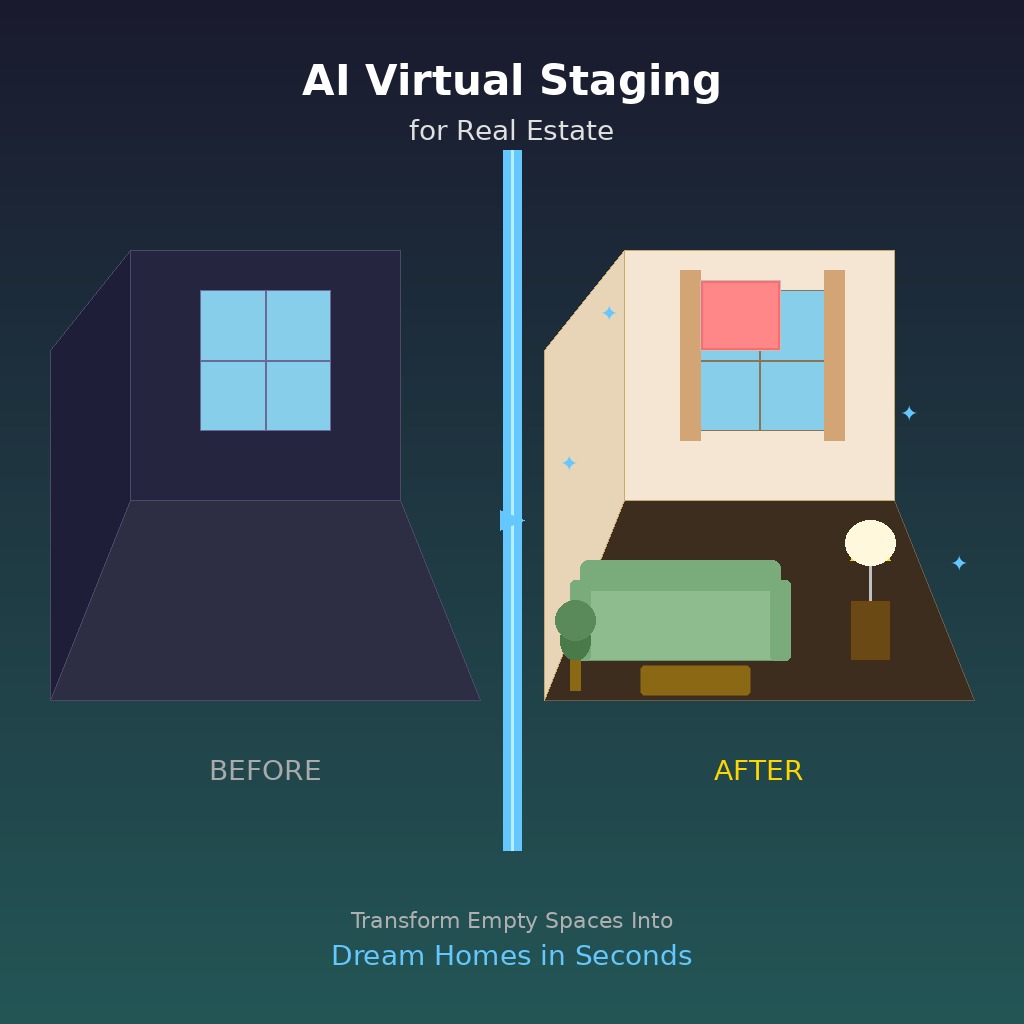
Introduction: The $8 Billion Staging Industry Meets AI
Virtual staging has become the single most impactful technology shift in residential real estate marketing since the introduction of online listings. Traditional home staging — physically furnishing empty properties for showings — costs between $2,000 and $8,000 per home and takes days to arrange. In 2026, AI-powered virtual staging achieves comparable results in under 60 seconds for as little as $15 per image.
The numbers tell a compelling story: according to the National Association of Realtors' 2026 Digital Marketing Report, AI-virtually-staged listings receive 74% more online views, generate 31% more showing requests, and sell an average of 9 days faster than unstaged equivalents. For the 5.5 million homes sold annually in the United States alone, that represents billions in accelerated transactions.
But AI virtual staging in 2026 goes far beyond simply placing furniture in empty rooms. Advanced models can now renovate kitchens, change flooring, adjust lighting for golden-hour warmth, remove clutter from occupied homes, and even transform exterior landscaping — all from a single smartphone photo.
This comprehensive guide explores how real estate professionals are leveraging these tools, examines the most effective workflows, and provides actionable strategies for agents looking to gain a competitive edge in their market.
How AI Virtual Staging Works: The Technology Behind the Magic
Understanding Diffusion-Based Inpainting
Modern AI virtual staging relies primarily on diffusion models — the same technology powering tools like Stable Diffusion, DALL-E, and Midjourney — but fine-tuned specifically for interior design and architectural contexts. These models have been trained on millions of professionally designed interiors, learning the visual grammar of furniture placement, lighting, and spatial relationships.
The process typically involves three steps:
- Scene Understanding: The AI analyzes the input photo to identify room boundaries, floor planes, wall surfaces, windows, and existing fixtures
- Semantic Segmentation: Empty floor areas, bare walls, and outdated elements are identified as regions available for staging
- Contextual Generation: New furniture, decor, and design elements are generated directly into the scene, matching perspective, lighting, and shadow geometry
The Evolution from 2024 to 2026
Early AI staging tools in 2024 often produced obvious artifacts — furniture with impossible shadows, inconsistent wood grain patterns, or objects floating slightly above floor surfaces. The 2026 generation of models has largely eliminated these issues through several key advances:
- Physics-aware rendering: Models now understand gravity, reflection, and light bounce
- Material consistency: Generated surfaces maintain realistic texture at all zoom levels
- Spatial coherence: Furniture respects room geometry, avoiding collisions with walls or existing fixtures
- Style transfer accuracy: Requested design styles (mid-century modern, Scandinavian minimalist, luxury contemporary) are rendered with high fidelity
Top AI Virtual Staging Tools for Real Estate in 2026
1. Virtual Staging AI (virtualstagingai.app)
Best for: High-volume agents needing quick turnaround
Virtual Staging AI remains the market leader with a 40% share of the professional real estate staging market. Their platform processes over 2 million images monthly and offers:
- 16 pre-built design styles from farmhouse to ultra-luxury
- Room-type detection for optimized furniture selection
- Batch processing for entire listing photo sets
- MLS-compliant disclosure watermarking
- Starting at $16 per staged image
Workflow: Upload photo, select room type, choose style, generate in 15–30 seconds. Most agents find that 2–3 variations per room produces at least one publication-ready result.
2. Apply Design (applydesign.io)
Best for: Agents wanting renovation visualization alongside staging
Apply Design differentiates itself by combining virtual staging with renovation visualization. Agents can show buyers not just how a room looks furnished, but how it could look with updated countertops, new flooring, or removed walls:
- Kitchen and bathroom renovation previews
- Exterior makeover visualizations
- Landscape redesign capabilities
- Integration with contractor cost estimation APIs
- Starting at $24 per image for combined staging + renovation
3. REimagineHome
Best for: Luxury market agents requiring photorealistic quality
REimagineHome targets the luxury segment with models trained specifically on high-end interiors. Their output quality is frequently indistinguishable from professional interior photography:
- 4K output resolution (4096 x 4096)
- Designer-curated furniture catalogs with real brand items
- Custom style training for consistent brand aesthetics
- White-glove service for ultra-luxury listings
- Starting at $39 per image
4. Getfloorplan + Staging Bundle
Best for: Agents wanting complete visual marketing packages
Getfloorplan combines AI-generated floor plans with virtual staging, creating comprehensive visual packages that include:
- Interactive 3D floor plans
- Staged room renders from multiple angles
- Virtual tour integration
- Furniture placement suggestions based on room dimensions
- Bundle pricing starting at $79 per listing
5. Palette by Styldod
Best for: International agents and property managers
Palette offers multilingual support and design styles calibrated for different regional markets — recognizing that a well-staged apartment in Tokyo looks fundamentally different from one in Miami:
- 30+ regional design styles
- Metric and imperial measurements
- Integration with international MLS platforms
- Bulk pricing for property management portfolios
- Starting at $12 per image
Real-World Workflows: How Top Agents Use AI Staging
Workflow 1: The Empty Listing Speed Play
Agent Profile: Maria Rodriguez, Keller Williams, Austin TX — 47 listings closed in 2025
Maria receives keys to a new vacant listing on Monday morning. Her workflow:
- 9:00 AM: Professional photographer shoots 25 images of the empty property
- 10:30 AM: Maria uploads all images to Virtual Staging AI via their batch API
- 11:00 AM: She selects "Modern Farmhouse" style for main living areas and "Contemporary" for bedrooms
- 11:30 AM: 25 staged images are ready. She reviews and regenerates 3 that need adjustment
- 12:00 PM: Listing goes live on MLS with fully staged photos
Total staging cost: $400 (25 images x $16) Time invested: 90 minutes of review time Comparable physical staging: $4,500 + 2 days of coordination
Maria reports: "My staged listings average 12 days on market versus 28 for vacant unstaged. That is a 57% reduction. For a $400 investment, I am generating tens of thousands in faster closings and happier sellers."
Workflow 2: The Occupied Home Declutter
Agent Profile: James Park, Compass, Seattle WA — specializes in family homes
The occupied home presents a different challenge. Sellers' personal items, children's toys, and general clutter can make otherwise beautiful homes photograph poorly. James uses AI to "virtually declutter" without asking sellers to physically reorganize:
- Photograph normally: Capture the home as-is, including lived-in elements
- AI declutter: Use object removal to eliminate personal photos, excess furniture, and clutter
- Enhancement pass: Adjust lighting to brighten dark corners and add warmth
- Selective staging: Add accent pieces — a fresh flower arrangement, styled bookshelves — to existing furniture
"The key insight," James explains, "is that most occupied homes do not need full staging. They need editing. AI lets me show the home at its best without asking a family with three kids to maintain a show-ready house for six weeks."
Workflow 3: The Renovation Visualization Close
Agent Profile: Lisa Chang, Coldwell Banker, San Francisco CA — luxury market specialist
Lisa uses AI staging strategically during negotiations, not just for listings:
- During buyer tours: When a buyer hesitates about an outdated kitchen, Lisa pulls up her tablet and shows an AI-generated renovation visualization in real-time
- Offer justification: She includes renovation visualizations in offer packages to help sellers understand why a buyer might offer below asking
- Pre-listing consultation: She shows sellers what their home could look like with minor updates, motivating $5,000 investments that yield $30,000+ in sale price
"I closed a $3.2 million deal last month because I could show the buyer, standing in the dated 1990s kitchen, exactly what a $80,000 renovation would look like. She made an offer that afternoon."
SEO Strategies for AI-Staged Listing Photos
Optimizing Image Alt Text
Every staged photo uploaded to your listing should include descriptive alt text that captures both the room and the design style:
- Poor: "living room staged"
- Good: "Spacious open-concept living room with modern farmhouse staging featuring neutral tones, linen sofa, and reclaimed wood coffee table"
File Naming Conventions
Rename staged images before uploading to your website or MLS:
123-oak-street-living-room-modern-farmhouse-staged.jpg
123-oak-street-primary-bedroom-scandinavian-minimal-staged.jpg
123-oak-street-kitchen-renovation-visualization.jpg
Schema Markup for Staged Photos
Add structured data to your listing pages indicating that virtual staging has been applied. This transparency builds trust with search engines and consumers:
{
  "@type": "ImageObject",
  "name": "Virtually Staged Living Room",
  "description": "AI-generated virtual staging showing modern farmhouse design",
  "caption": "Virtual staging - furniture not included in sale"
}
Legal and Ethical Considerations
Disclosure Requirements
As of 2026, 43 US states require explicit disclosure when listing photos include virtual staging. The National Association of Realtors updated their Code of Ethics in 2025 to include Standard of Practice 12-14, which states:
"Members shall clearly identify any digitally altered or virtually staged photographs in property listings, including but not limited to furniture addition, item removal, renovation visualization, or environmental modification."
Best practices for disclosure:
- Add a small watermark reading "Virtually Staged" to each modified image
- Include a written disclosure in the MLS remarks: "Select photos have been virtually staged to show design potential"
- Provide original unmodified photos alongside staged versions
- Never alter structural elements (window sizes, room dimensions, ceiling heights) without clear labeling
Fair Housing Compliance
AI staging tools must be used in compliance with Fair Housing Act requirements. Agents should ensure that:
- Staged images do not exclusively show decor or art that could indicate preference for specific protected classes
- Style choices are based on market demographics and design trends, not discriminatory intent
- The same staging quality and effort is applied regardless of neighborhood demographics
Measuring ROI: The Numbers That Matter
Key Performance Indicators
Track these metrics to quantify your AI staging investment:
| Metric | Without AI Staging | With AI Staging | Improvement |
|---|---|---|---|
| Days on Market | 34 avg | 21 avg | -38% |
| List-to-Sale Ratio | 96.2% | 98.7% | +2.5 pts |
| Online Views (first 7 days) | 847 | 1,473 | +74% |
| Showing Requests (first 14 days) | 8.3 | 10.9 | +31% |
| Price Reductions | 23% of listings | 14% of listings | -39% |
Cost-Benefit Analysis
For an agent closing 30 transactions annually:
- Annual AI staging investment: $12,000 (avg 10 images per listing x $40 per image)
- Revenue from 9 faster days per listing: Approximately $45,000 in reduced carrying costs for sellers
- Additional listings from reputation: 3–5 referral listings from impressed sellers
- ROI: 375%+ when accounting for referral business
Advanced Techniques for 2026
Twilight Conversion
One of the most powerful AI staging techniques converts daytime exterior photos into dramatic twilight (dusk) shots. Professional twilight photography requires a photographer to return at sunset — AI achieves the same effect from any daytime photo:
- Warm interior lighting glows through windows
- Sky transitions to deep purple and orange gradients
- Landscape lighting appears along pathways and facades
- The overall emotional impact is significantly elevated
Listings with twilight hero images receive 40% more saves and shares on Zillow and Realtor.com.
Seasonal Transformation
For listings that photograph poorly in winter (bare trees, dead grass, grey skies), AI can generate summer-equivalent exterior shots. This must be clearly disclosed, but it helps buyers visualize the property's full potential:
- Lush green landscaping replaces dormant winter yards
- Blue skies and warm lighting replace overcast conditions
- Flowering plants and mature foliage frame the property
Multi-Style A/B Testing
Sophisticated agents now generate the same room in 3–4 different design styles and monitor which version generates the most engagement:
- Upload staged variations to your property website
- Track click-through rates and time-on-image for each version
- Use the highest-performing style for the MLS listing
- Adjust future staging choices based on what resonates with your market
Common Mistakes to Avoid
1. Over-Staging
Adding too much furniture makes rooms appear smaller. AI tools default to filling every space — override this by specifying "minimal" or "open" in your style preferences. A room should feel inviting, not crowded.
2. Style Inconsistency
Mixing mid-century modern in the living room with traditional in the bedroom creates cognitive dissonance for buyers. Maintain a cohesive design language throughout the property, varying only in intensity (more decorated common areas, simpler bedrooms).
3. Ignoring Scale
Some AI models generate furniture at incorrect scale — a sofa that appears too small for the room, or a dining table that would not physically fit. Always verify proportions against known reference points (doorways, windows, standard ceiling heights).
4. Neglecting Shadows and Lighting Direction
The most common tell of amateur virtual staging is inconsistent lighting. Ensure that AI-generated furniture casts shadows in the same direction as existing shadows in the photograph. Premium tools handle this automatically; budget tools may require manual review.
5. Forgetting Mobile Optimization
Over 60% of initial listing views happen on mobile devices. Staging that looks impressive on a desktop monitor may be too subtle to register on a phone screen. Use bold, high-contrast staging choices that read well at small sizes.
Getting Started: Your First AI Staging Project
Step 1: Choose Your Tool
For beginners, Virtual Staging AI or Palette offer the lowest learning curve. Sign up for a free trial and stage 3–5 images to evaluate quality.
Step 2: Photograph Intentionally
Even with AI enhancement, photo quality matters. Follow these shooting guidelines for optimal AI staging results:
- Shoot from corner angles that show maximum floor space
- Ensure consistent, bright lighting (open all blinds, turn on all lights)
- Use a wide-angle lens (16–24mm equivalent) but avoid extreme distortion
- Keep the camera level — tilted perspectives confuse AI models
- Remove obvious personal items that would need AI removal (saves processing artifacts)
Step 3: Develop Your Style Library
Create a reference document of 3–4 design styles that work for your market segment. Include example images, color palettes, and furniture preferences. This consistency builds brand recognition across your listings.
Step 4: Establish Your Disclosure Protocol
Draft standard disclosure language for your MLS entries and listing presentations. Consistency in disclosure protects you legally and builds trust with buyers.
Step 5: Track and Iterate
Document your results from the first 10 staged listings. Compare days on market, online engagement, and showing requests against your unstaged historical data. Use these metrics to refine your approach and justify the investment to future seller clients.
The Future of AI in Real Estate Photography
Emerging Capabilities for Late 2026 and Beyond
- Video staging: AI-staged virtual tours with walk-through video generation
- Real-time AR staging: Buyers see staged furniture through their phone cameras during in-person tours
- Predictive staging: AI selects styles based on the most likely buyer demographic for each listing
- Automated listing creation: Photo-to-listing pipelines that generate descriptions, select staging styles, and publish to MLS platforms with minimal agent input
The Agent's Role Is Evolving
AI staging does not replace the real estate agent — it amplifies their expertise. The most successful agents in 2026 are those who understand design principles, know their local market's aesthetic preferences, and can guide AI tools toward results that resonate with specific buyer pools.
The technology handles execution. The agent provides strategy, local knowledge, and the human judgment that turns a staged photo into a sold home.
Conclusion: Staging Is No Longer Optional
In a market where buyers form opinions within 3 seconds of viewing a listing photo, professional presentation is not a luxury — it is a necessity. AI virtual staging has democratized access to high-quality visual marketing, allowing every agent, regardless of budget, to present properties at their absolute best.
The agents who thrive in 2026 are not those with the biggest marketing budgets. They are those who embrace intelligent tools, maintain ethical standards, and never stop refining their visual storytelling craft.
Your next listing deserves more than empty rooms and harsh lighting. Give it the AI staging advantage — and watch the offers come in faster than ever.
Ready to transform your property listings with AI? Explore our comprehensive guide to AI image generation tools for more options, or learn about AI photo enhancement techniques to elevate every image in your marketing arsenal.
Ready to try it yourself?
Try AImage for Free →